
Search for "Chicken Road strategy" and you'll find plenty of claims about pattern-spotting, hot streaks, and systems that supposedly beat the game. None of that changes the fact that Chicken Road runs on an independently audited random number generator: each hop's outcome is generated fresh, with no memory of previous rounds. What follows isn't a way to beat the house edge — it's a set of realistic, honest approaches to managing risk and decision-making, which is the only part of the game actually within a player's control.
Why "Strategy" in Chicken Road Really Means Risk Management
In games of pure chance with an independent RNG, the term strategy is often misused to imply an edge that doesn't exist. What genuinely differs between a disciplined player and an undisciplined one isn't the outcome of any single round — it's how consistently they manage stake size, cash-out timing, and stopping points across a whole session. That's the frame for everything below.
Fixed Cash-Out Targets
One of the simplest approaches is deciding on a target multiplier before the round starts and sticking to it — for example, always cashing out at 1.3x, or always at 2x, regardless of how confident the round "feels." This removes the temptation to keep pushing further after a lucky streak of hops, which is often where the largest single-round losses happen. It doesn't improve your statistical odds, but it does replace a real-time emotional decision with a pre-committed rule, which many players find easier to stick to under pressure.
Difficulty-Level Discipline
Because Chicken Road's difficulty settings trade hop-safety probability against multiplier growth, switching difficulty mid-session in response to recent wins or losses is a common way sessions spiral. A steadier approach is picking one difficulty level appropriate for your bankroll and sticking with it for the whole session, rather than moving to Hardcore mode after a win in the belief that a streak will continue — a belief the RNG doesn't support.
Session Bankroll Sizing
A commonly cited rule of thumb among players who track their own play is to set a total entertainment budget for a session in advance — money you are fully prepared to lose — and to further divide that into a per-round stake that lets you play a reasonable number of rounds without exhausting the budget in a handful of unlucky hops. There's no universal "correct" percentage; the important part is deciding the number before you start playing, not adjusting it upward mid-session.
| Session Budget | Illustrative Per-Round Stake (1-2%) | Approx. Rounds Covered |
|---|---|---|
| $20 | $0.20 – $0.40 | 50 – 100 |
| $50 | $0.50 – $1.00 | 50 – 100 |
| $100 | $1.00 – $2.00 | 50 – 100 |
| $200 | $2.00 – $4.00 | 50 – 100 |
These figures are purely illustrative arithmetic, not a projection of outcomes — they simply show how a fixed percentage rule translates into a per-round stake at different budget sizes.
Setting a Stop-Loss and a Stop-Win
Two boundaries are worth deciding in advance:
- Stop-loss — a total amount that, once lost in a session, ends play for that day regardless of how the next round "should" go.
- Stop-win — a target gain at which you walk away rather than continuing to push, since it's common for sessions to give back earlier winnings if play continues indefinitely.
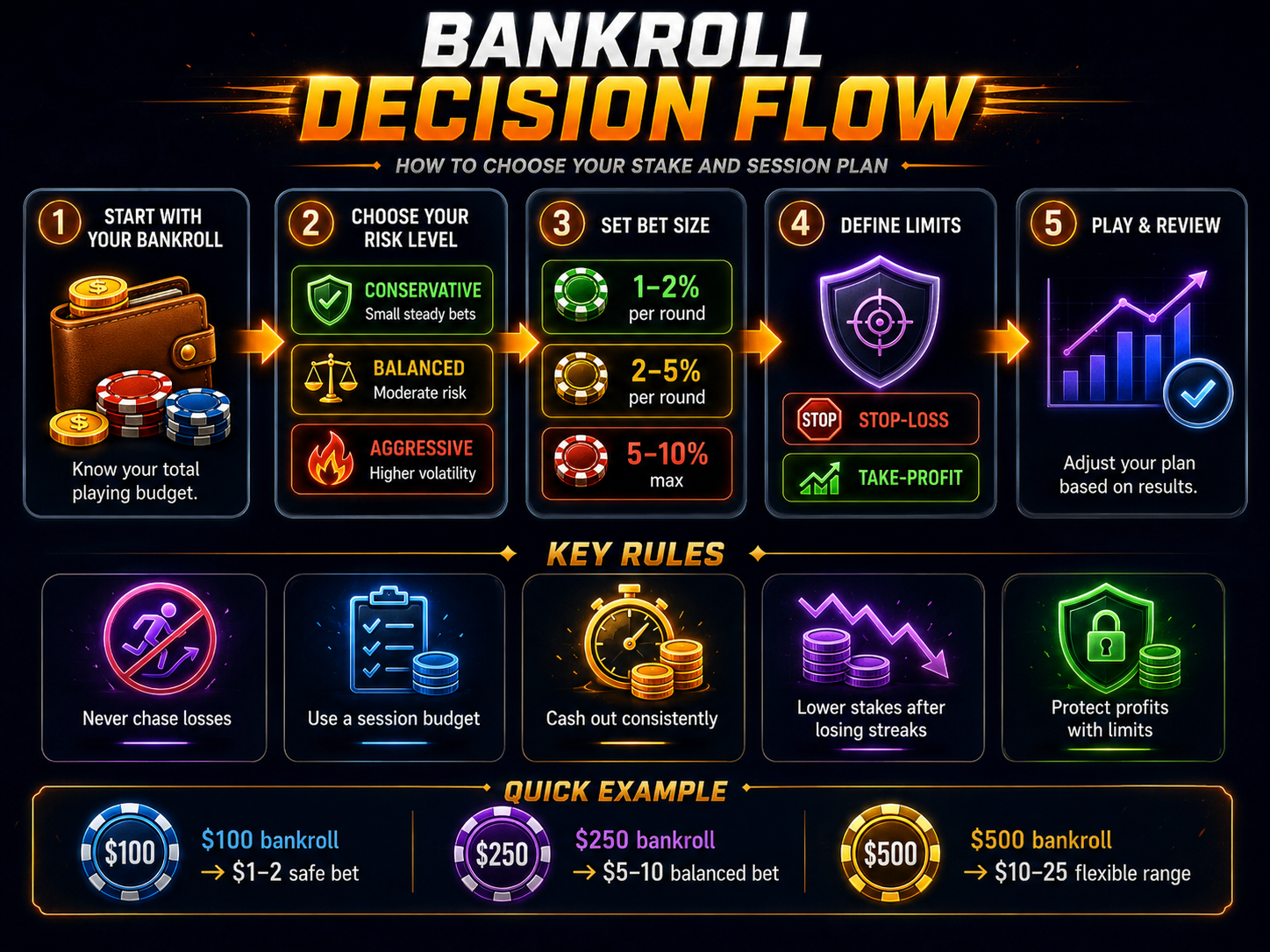
Both boundaries only work if they're treated as firm rules decided in a calm moment, not suggestions to be renegotiated mid-session.
Why Betting Progressions Don't Work Here
Progressive betting systems — doubling a stake after a loss, or increasing it after a win, following patterns like Martingale — are frequently suggested for crash-style games. They don't change the underlying probability of any individual hop, and because Chicken Road rounds can end abruptly, a progression can require an increasingly large stake right at the point a bankroll is most depleted. These systems redistribute risk; they do not reduce it or create an edge.
Common Bankroll Mistakes to Avoid
Beyond progression systems, a few other habits quietly undermine even a well-intentioned budget:
- Topping up mid-session — depositing more once the original budget is gone effectively erases the limit that was supposed to define the session in the first place.
- Counting winnings as "extra" money to risk — treating money won during a session as separate from the original stake often leads to giving it all back, since it's still real money subject to the same house edge.
- Ignoring session length alongside spend — a budget limit without a time limit can still turn into a much longer session than intended, especially late at night when judgment tends to be weaker.
- Comparing your bankroll to other players' — session sizes that work for someone else's finances say nothing about what's appropriate for yours; the right number is set relative to your own entertainment budget, not anyone else's.
Recognizing Problem Gambling Signs
Because Chicken Road is fast-paced and easy to keep playing "for one more round," it's worth being able to recognize the difference between entertainment spending and a pattern that's become a problem. Signs worth taking seriously include: spending noticeably more time or money than planned on a regular basis, borrowing money to fund play, lying to people close to you about how much you play, feeling anxious or irritable when you try to cut back, and using Chicken Road or similar games to escape stress or other problems rather than for enjoyment. None of these require every box to be checked — even one or two recurring patterns are worth acting on.
If any of this sounds familiar, most licensed casinos offer self-exclusion and deposit-limit tools directly in account settings, and free, confidential national helplines exist in most regulated markets independent of any casino. Using them is not an admission of failure — it's the same kind of practical boundary-setting this whole page has been discussing, just applied at a level a personal budget alone can't address.
Recognizing When Play Has Stopped Being Fun
Because Chicken Road (like all crash games) is fast-paced and offers frequent small decision points, it's worth periodically checking in with yourself: are you still playing for entertainment within a budget you set in advance, or has the session become about recovering losses or chasing a specific number? If it's the latter, stepping away — for that session and, if the pattern repeats, for longer — is the most reliable "strategy" available.
A Realistic Summary
There is no combination of cash-out timing, difficulty selection, or staking pattern that overcomes Chicken Road's built-in house edge over a large number of rounds. The approaches above are about making sessions more deliberate and less prone to the kind of in-the-moment decisions that turn entertainment spending into something bigger than intended — nothing here is a guarantee of profit, and none of it should be treated as one.