
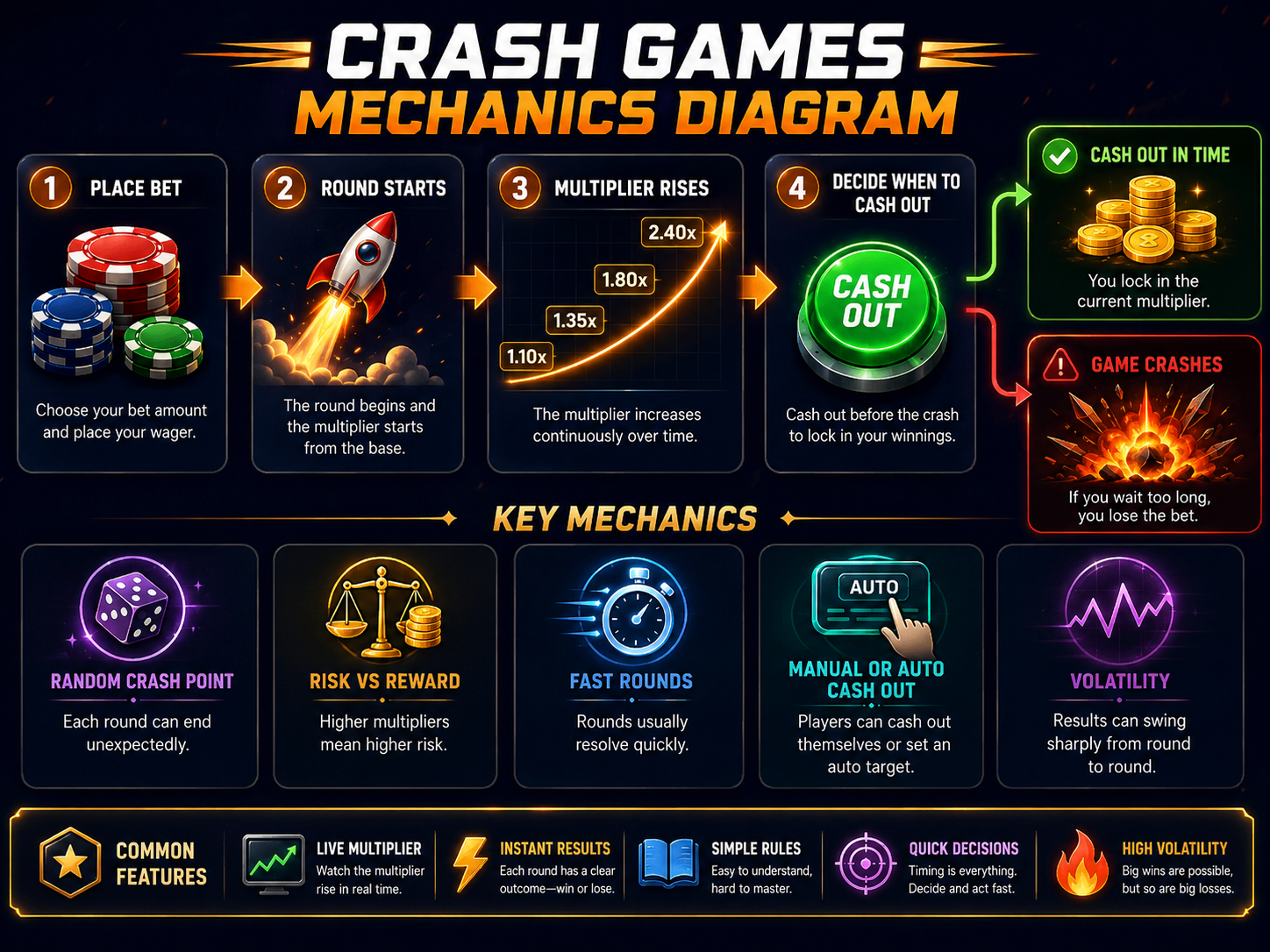
Chicken Road is one of several games built around the same core mechanic: a multiplier that grows the longer you stay in, matched against the risk that the round can end at any moment. What differs between titles is how that risk is presented, how quickly the multiplier moves, and how much control the player feels they have over the timing of their cash-out. This page compares Chicken Road with the crash games players most often mention alongside it.
| Game | Progression | Typical Pacing | Bonus Events | Social Feed |
|---|---|---|---|---|
| Chicken Road | Discrete hops | Moderate | No | No |
| Aviator | Continuous curve | Fast | No | No |
| JetX | Continuous curve | Fast | Yes | No |
| Aviatrix | Continuous curve | Fast | No | Yes |
| Spaceman | Continuous curve | Fast | Yes | No |
Chicken Road vs Aviator
Aviator is arguably the title that popularized the crash genre in its current casino form: a plane climbs along a continuously rising curve, and the multiplier increases in real time until the plane "flies away," ending the round. The core difference from Chicken Road is continuity versus discreteness. In Aviator, you are watching a smooth curve and can cash out at any instant; in Chicken Road, the game advances in distinct hops, and your decision point comes after each one rather than continuously.
This changes the pacing of a session considerably. Aviator rounds tend to move fast and can end at any fraction of a second, rewarding quick reflexes or pre-set auto-cashout targets. Chicken Road gives a players a beat to think between each hop, which many find calmer, even though the underlying uncertainty is mathematically similar.
| Feature | Chicken Road | Aviator |
|---|---|---|
| Progression style | Discrete hops | Continuous curve |
| Decision point | After each hop | Any instant |
| Typical pacing | Moderate | Fast |
| Risk customization | Difficulty levels | Auto-cashout target |
Chicken Road vs JetX
JetX follows the same continuous-curve format as Aviator but adds visual bonus events — occasional in-round multiplier boosts tied to the jet passing certain markers. Chicken Road doesn't use randomized mid-round boosts; instead, its variance comes entirely from the difficulty setting chosen before the round and the sequence of hop outcomes within it. Players who prefer predictable, rules-based variance rather than surprise bonus events tend to gravitate toward Chicken Road; those who enjoy occasional extra multiplier spikes often prefer JetX.
Chicken Road vs Aviatrix
Aviatrix is another continuous-curve title, similar in structure to Aviator, but frequently offered with a live multiplayer feed showing other players' cash-out points in real time. That social visibility is a meaningful point of difference — it can create pressure to cash out early or hold longer depending on what others appear to be doing, which introduces a psychological dimension that Chicken Road, typically played as a single-player round without a visible feed, does not have.
Chicken Road vs Spaceman
Spaceman uses the same rising-curve format with a space theme and occasional bonus multiplier events, positioning it closer to JetX than to Chicken Road structurally. The key difference for Chicken Road remains its lane-based, incremental design, which breaks a round into a series of smaller, separately-weighted decisions rather than one continuously accelerating curve.
Which Style Suits Which Player
- Players who like a pause to think — Chicken Road's per-hop structure suits players who want a beat to decide rather than reacting to a fast-moving curve.
- Players who like fast, high-frequency rounds — continuous-curve games like Aviator and JetX often move quicker round to round.
- Players who like visible difficulty control — Chicken Road's explicit Easy/Medium/Hard/Hardcore settings give a clearer, upfront sense of the risk being taken than an auto-cashout target alone.
- Players who enjoy social or competitive elements — multiplayer-feed titles like Aviatrix add a layer Chicken Road does not typically include.
The Common Thread
Whichever title you're drawn to, the fundamental math is the same across the genre: house edge is built in, past rounds don't influence future ones, and no observation of a live feed or pattern of recent results changes the odds of what happens next. Genre preference in crash games is almost entirely about pacing and presentation, not about finding a title with better real odds — differences in RTP between mainstream titles are typically marginal.
A Brief History of the Crash Game Genre
The crash format traces back to early provably-fair crypto-casino experiments, where a simple rising-multiplier curve with a random crash point was easy to build, easy to verify cryptographically, and easy to understand at a glance — no reels, no paylines, just one number climbing until it stops. Aviator is widely credited with bringing the format to a mainstream casino audience at scale, and its commercial success prompted a wave of similarly-structured titles from other studios, each looking for a way to differentiate visually while keeping the core mechanic that made the genre popular in the first place.
Chicken Road represents one of the more structurally distinct responses to that wave: rather than reskinning the continuous curve, it breaks the same underlying risk-and-reward idea into discrete, lane-by-lane steps. That reframing didn't change the math, but it did open the format up to players who found a fast, continuously-moving number harder to track than a series of separate go/no-go decisions.
Volatility and Math Model: What Actually Changes Between Titles
Even though every game in this comparison shares the same broad concept, the specific probability model behind each one differs in ways that affect how a session feels, if not its long-run average. Continuous-curve titles like Aviator typically generate a single random "crash point" per round using a provably fair algorithm, and the multiplier climbs continuously toward that hidden point. Chicken Road instead assigns an independent safe/unsafe probability to each discrete lane, with the difficulty setting adjusting that per-lane probability directly. The practical effect is that Chicken Road's volatility is a setting you choose explicitly before the round starts, whereas continuous-curve games bake their volatility profile into the game's fixed configuration, with player control limited to when they choose to cash out.
Neither approach is mathematically superior — both are ways of distributing the same house edge across a probability curve. The choice between them comes down to whether a player prefers to set volatility upfront through an explicit setting, or to manage it in the moment through cash-out timing on a continuously moving number.